Tuesday, June 20, 2006

10 indicators to evaluate basic standards of life of a Muslim community

being an economist, my job is to evaluate with measures and indicators. i often pondered a lot as to what will be an optimal(not necessarily the best) list of 10 indicators to evaluate the basic standards of life of any Muslim community in any country across the globe

well till now i am still debating within myself... but i guess i will list a preliminary list and work on it :)

1) poverty rate (definition of poverty: those who do not have the means to consume 3 meals per day)

2) access to pure drinking water

3) access to basic/emergecy medical services

4) rate of homelessness

5) literacy rate including quranic literacy

6) responsiveness for the growth in madrasahs

7) divorce rate

8) unemployment rate

9) crime rate

10) responsiveness for the growth in mosques and their services.

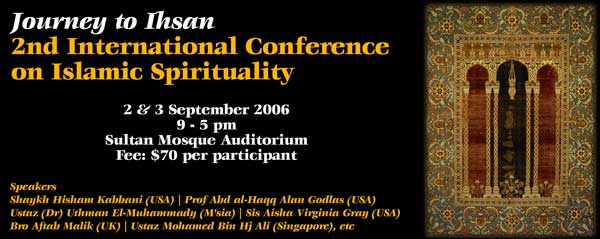
2nd International Conference on Islamic Spirituality

2nd International Conference on Islamic Spirituality


A good departure from the typical conferences held here in Singapore which tirelessly dwell upon contemporary discussions.

For the typical contemporary topics, the Muslim audience get to hear what they like to hear and it tends to be largely popular. But contemporary topics tend to be chiefly subjective which can be discussed till eternity without seeing an end or change. Likewise you cant see quite an observable impact or difference on the audience as they bring back little that which can truely enrich their lives.

In traditional topics like above, the audience can get to hear what is useful, resourceful, beneficial and helpful for them to hear where they can bring back something strong and useful which they can individually and privately work on.

A must go................... for info click ................ here

Tuesday, May 23, 2006

Economic impoverishment of the Muslim world and the insufficient commitment by the affluent Muslim countries to tackle it.

Being trained as an economist, I tend to spend time looking at different kinds of data and indicators that reflect the economic conditions of countries. I particularly and naturally often get distracted to pay attention to Muslim countries. However the results are more than often dismal.


Much of the Muslim world today lives in dire poverty while much of Muslim world lives in unimaginable wealth. Though sense of Muslim Brotherhood has always traditionally been central and pivotal in Islam, because Muslims have drifted away from the traditions to adopt secularism, culturalism, nationalism and puritanism, this sense of Ummah has naturally died as everyone commonly feels their cultural or national identity stronger than the identify of their faith. Hence there is little concern for one “limb of the ummah” when the “other limb of the ummah” suffers, in absolute contradiction to the message and guidance delivered by the Holy Prophet (peace be upon him). What is even worse is that in many instances, there is no concern shown by Muslims for the people of their own ethnicity even. Instead in almost every Muslim country one can find, a minority proportion of population hoarding the wealth of the nation and refusing to share it with the impoverished. The worst rascals are always the ones who has the access and means to use their office to swindle public money.


I was reading an article in BBC where they were reporting on a Muslim widow with three kids in Afghanistan. She explained how her life became so miserable when her husband died, disabling her ability to feed herself and kids. However when some NGO donated a cow to her, she thereafter ever since has been able to sustain supporting her family. Indeed the economic impoverishment of Muslims around the globe cannot be remedified by giving each a cow. However this life story shows there are simple solutions that can be implemented to alleviate much hardships and poverty of many impoverished Muslims around the world. A cow will probably cost around US$500. What is US$500 to the Saud family that used to spend $6million per day in Switzerland whenever the late King Fahd went to Switzerland for treatment? What is US$500 to the Dubai royals who are spending more than US$200 million to build the largest luxury yacht? What is US$500 to Colonel Gaddafi who spends millions to finance IRA and other fringe groups?


I don’t believe these thoughts never cross their minds even once. Yet their indifferent attitude and continued indulgence in satisfying their insatiable lust to spend on themselves or their self-defined objectives blind them to the sorrow and agony of their fellow brethren.


What is US$500 to Osama Bin Laden, who I bet have had much more first hand experience encountering not just the reality of the poverty, impoverishment and agony of Afghanis but also the extent of it? What mission can any Muslim argue to be more important when he has a duty to save the lives of his brethren, who are dying at his feet from hunger and disease, using his abundant wealth?


When I was in university I had a friend from Chad who informed me of how Chad don’t even have a proper library and how the kids go to school with no paper, pen or pencil. How difficult will it be for any Muslim country to fund the establishment of a comprehensive library in Chad?


I have also heard from Palestinian friends and read in research papers during economics development classes of how Palestinians do not even have proper running water. Indeed what proportion of Muslim world has access to running water, electricity, food and shelter? More importantly where is the commitment by the affluent Muslim countries to do their part to help out?


Affluent Muslim countries love to showcase their sense of charity to impoverished nations to show otherwise. Dubai royal family always likes to display that they give out large amount of donations. Quwait government also love showcasing their development foundation. However they need to realize their relief aid amounts to an insignificant proportion of their GDP i.e. what they give out, from the abundance that Allah has given them, is insignificant.


Saudis also love showcasing their relief efforts which include funding schools and providing Qurans. From the experience and knowledge of everyone, we all know the intentions of Saudis to construct schools i.e. to spread their ideology of wahhabism. Indeed if only they realize their aid recipient countries such as Indonesia, have better technology, better paper and better printing and binding standards enough to print better and nicer copies of Quran than the Saudis themselves, they will see their foolishness in bothering to even send their copies of the Holy Quran to Indonesia.


Indeed affluent Muslim countries need to focus their current aid initiatives to high impact aid for recipient countries and commit a lot more to match their duties to give as Muslims. Token aid by affluent Muslim societies changes no real situation of no impoverished Muslim society.


What are the areas in which commitment by the affluent members/countries of the Ummah is urgently and pertinently required?


1) Emergency relief – A shameful section of the Ummah lives each day with no clean drinking water nor three meals. These areas need to be identified and continual emergency relief action need to be urgently set up. Sadly this role is played by non-Muslim organizations set up by non-Muslim countries, while leaders of our every affluent Muslim country contribute only his/her rhetoric for these distressed.

2) Basic amenities of life – A huge section of the Ummah lives with no basic amenities of life such as clean drinking water, electricity, heating or sanitation. Muslim relief organizations set up by affluent Muslim countries pride themselves whenever they undertake any such project. But least do these countries realize their relief efforts are a fraction of what they really need to commit and the change their contributions will bring about will be marginal until they commit as much as they are required to and responsible for.


3) Mass Employment – The above measures and subsequent measures cannot be undertaken without this one. Muslim aid countries need to develop sources of mass employment to employ unemployed labour force within the impoverished sections of the Ummah. Areas that which can yield mass employment opportunities when developed are agriculture, fishing and labour intensive industries. This creation of mass employment opportunities are an effective way to speedily bring out the impoverished sections of the Ummah from deprivation.


4) Universal Healthcare


Even within the affluent Muslim countries, healthcare remains not available or accessible to every Muslim but only to those who can privately afford it. In this the affluent Muslim countries including U.A.E etc, share the ranks of the most impoverished Muslim countries. They are equally incompetent in making healthcare services universally available to their native, resident and immigrant population. In this there is a room for collaborative effort since a coordinated and partnered development of universal healthcare throughout the Ummah through health insurance and effective planning can be more effective and yield economies of scale.


5) Universal Housing


Housing too remains not universal through the Muslim world. Islamic finance led real estate/housing developments ironically target only the affluent Muslims. I truly wonder what is Islamic about that kind of financial framework. Islamic finance need better models to facilitate mass housing projects across the Muslim world with the goal of achieving universal housing for the Ummah.


Muslim nations need to shrink their defense expenditures and re-allocate their resources to the earlier mentioned efforts. Affluent Muslim nations who are foolishly embarking on edification of their city landscapes need to better manage their resources intelligently and reallocate some resources to the earlier mentioned efforts. It is about time Muslim leaders allow their actions speak and their words shut.

New chapter of capitalist narrative — Farish A Noor

New chapter of capitalist narrative — Farish A Noor


Dr Farish A Noor is a Malaysian political scientist and human rights activist, based at the Zentrum Moderner Orient (ZMO), Berlin


The issue is not Islam or being Muslim; but rather racial and class discrimination which is not exclusive to Muslims. As long as the poor working class Muslims of Europe do not realise this, and do not try to bridge the gap with other poor working class communities, they will remain a culturally-defined minority that will remain perpetually on the margins


Across Europe today Islam and Muslims are being put to question. In early May the British National Party (BNP) contested local elections across the country calling the elections a “referendum on Islam”. In France similar questions were posed by the Front National on May 1. Likewise in Denmark and the Netherlands. All across Western Europe, citizens are being asked if they are willing to “put up” with the presence of Islam and Muslims in their midst.

Europe’s universalist pretensions have been laid bare and rendered hollow by the parochialism that now masks itself as nationalism. These countries look, sound and feel more like villages in the outback, where villagers are scared of the first black or brown face they see.

To make things worse, thanks to the vociferous campaigning by the extreme right, the political mainstream has also shifted to the right. In Britain, France, the Netherlands, Germany and Italy not a day passes without yet another flaccid editorial piece about “European identity being under threat” and the “failure of multiculturalism”. Western Europe bemoans the end of cosmopolitan pluralism and yet cannot grapple with the structural-economic reasons for the failure of nation building.


Rather than deal with concrete issues of class, power relations and power differentials between the majority and migrant communities, we have passed onto the more ambiguous and abstract register of cultural difference. If Europe cannot deal with Islam and Muslims, so we are told, it is because Muslims are “culturally different”. (Little is said about the “Others” who reside in Europe, including the millions of Jews, Hindus and Buddhists...)


The starting point of this spurious non-debate is the question of violence and instability. The right-wing Islamophobes point to the recent instances of riots by young Muslims in the ghettos and suburbs of London, Paris and other major cities of Western Europe. These instances of civil disobedience and conflict are, for many right-wingers, “proof” that Muslims are generally a burden and troublemakers who ought to be pacified, integrated or repatriated to their home countries. Muslims are presented as a “problem” that needs to be pathologised, analysed and solved. But was this not part of the programme in the first place?

The “programme” here refers to the Liberal-Capitalist project of Western Europe itself. Let us remember that the countries facing the “problem” of failed integration and failed multiculturalism happen to be developed capitalist states. As good political scientist or historian will remind us, capitalist states have always thrived on civil dispute, precariousness, instability and the politics of divide-and-rule.


Capitalism requires a surplus working class that can be played against itself and exploited at will. It requires a surplus of workers who can be domesticated, disciplined and co-opted when the needs of the market arises. Throughout the history of capitalism, the ruling commercial and political elites have sought to keep the workers divided along racial or communal lines so that they do not unite and stir up a revolution.


In the late 19th century the poor workers of England were pitted against the poor migrants from Ireland. The Irishman was cast as the poor white parasite who had descended upon the shores of England to steal jobs from honest English workingmen. Irishmen were contemptuously referred to as the “white niggers” of Europe who were savage drunkards and hooligans best kept at bay by the police baton (later rubber bullets and teargas).


The history of migration to countries like America, the United Kingdom, Netherlands, France and Germany is a record of successive waves of poor migrants being abused, demonised, exploited and turned against other equally poor communities.


Today the debate about “violent Muslims” strikes a resonant chord with this older narrative of mistrust and alienation. Europe’s Muslims are cast in culturalist terms as backward, violent, anti-social and untrustworthy; the way earlier migrants from Ireland and Greece etc and the Jews were portrayed. In all these cases the discussion of cultural difference is a convenient way to avoid a discussion on class, power differentials, institutionalised discrimination and exploitation by capital.


The net effect is also the same. Like the anti-Irish campaigns of the 19th and early 20th century, what is happening today is the division of the poor working classes of Europe along racial, ethnic and religious lines. Yet we often forget that the plight of poor Muslims in Europe is similar to the plight of poor Europeans as well. All these minority communities suffer from unequal mediatic and political representation, less access to education and the tools of governance, less legal protection (and too much policing).


How can the problem be solved? One way out would be for Muslims in Europe to emphasise their class and political identities more and their religio-cultural identity less. The issue is not Islam or being Muslim; but rather racial and class discrimination which is not exclusive to Muslims. As long as the poor working class Muslims of Europe do not realise this, and do not try to bridge the gap with other poor working class communities, they will remain a culturally-defined minority that will remain perpetually on the margins and treated like outsiders.


For too long Europe’s Muslims have blindly walked into the right-wingers’ trap of sectarian communal-religious identification and allowed themselves to be cast and seen exclusively as members of a religious community. Now they need to emphasise the universality of their class condition and see themselves for what they are: the poor and exploited of Europe, no different to the poor Irish of the past.

Monday, May 22, 2006

Medieval Islamic Economic Thought

i am impressed by this book. almost all the islamic economists have really neglected the study of the contributions of the various Islamic scholars during this medieval period that later translated to growth of European Medieval Economic thought. at the most the only medieval scholar that islamic economists have covered is ibn khaldun. this book is a must read

Medieval Islamic Economic Thought
Hardcover: 320 pages
Publisher: RoutledgeCurzon; 1 edition (August 1, 2003)
Language: English
ISBN: 0415297788

Why doesn’t Islamic Economics study the more serious questions of allocation and reallocation of resources in Ummah/Muslim societies?

Why doesn’t Islamic Economics study the more serious questions of allocation and reallocation of resources in Ummah/Muslim societies?


I am still struggling to find a consistent definition of I.E. and after having talked/discussed with a number of Islamic economists, I discovered they too don’t quite have an universal definition. Anyway I guess failure by Islamic economists to hold an universal definition has resulted in the growth and direction of Islamic Economics being influenced by the champions of it. You see when any field is not properly or consistently or appropriately or concisely defined then the direction it will take will be dependent upon its champions whose values, perceptions, bias and ideals will be influencing factors. In the case of I.E. we have seen finance dudes, businessmen and politicians have been the main champions. I.E academics also have been mainly those who come from cultures where thought, ideas and information are dominated by the earlier group. Hence naturally I.E. have grown in the direction of money, finance and banking.


I find it sad to see this because if we simply take a generalized definition of I.E. which is that it’s a study on the allocation and reallocation of resources in society, then we find that in this question of allocation and reallocation of resources in any Muslim society or Ummah as whole, the greatest challenges, problems and need are not in areas of money, finance and banking. Yet the direction the best and powerful amongst the Ummah can take in analyzing allocation and reallocation of resources within our Ummah is towards those less pressing areas. It reviles me further when I realize there are such painful problems for the Ummah such as poverty, which manifests in two severe forms which have been given lesser priority by fellow Muslim leaders, scholars and academics. In the worst form of poverty, there is a good proportion of Ummah who are within the scope of poverty called “poverty without hope” where they are struggling each day for basic food, water and medicine. To them each day is a question of life and death. There is the other lesser form of poverty which afflicts an even greater proportion of the Ummah, where those within this fold of poverty do not have jobs, ability to go to school, roof over their heads, clean drinking water, basic sanitation etc. There is such great enthusiasm in erecting institutions and organizations to study and carry out allocations and reallocations of resources in the areas of “Islamic” finance and banking. But where are the institutions to address the allocations and reallocations of resources in the areas of poverty and economic deprivation.


A shameful proportion of the Ummah still does not have a roof over their head. With housing being not universal for the Ummah why are politicians, businessmen and academics only concerned about housing for the affluent such as Riba free mortgages etc? Where is the egalitarianism that Islam is all about in the practice of Islamic finance in the housing market? Why isn’t there decent efforts being employed to devise solutions within Islamic finance to improve house ownership rates amongst the less privileged?


Much of the Muslim world remains without decent public transportation systems. Why isn’t there decent efforts being employed to devise solutions within Islamic finance to address the problem of universal basic transportation whereas every effort is not spared to address the problem of automobile car ownership for the affluent ones?


It is so disgusting to see the discourse, study and implementation of Islamic Economics being focused along the marginal and not the social or ummah which is even more wider than the social. The evolution of Muslim societies till the fall of the Ottoman caliphate simply worked in the opposite direction building on the social and Ummah and not on the marginal like the post Caliphate, post Independence Muslim societies. Perhaps this may explain the failures of the Ummah where it remains to see any form of barakah(blessings) not even equivalent to proportions in fractions that Muslim societies till fall of Ottoman caliphate reaped.

Sunday, January 29, 2006

Standard of Life Vs Quality of Life

I was glanzing through UNDP's Human Development Index which ranks countries according to standard of living. As I went through it, I could not help but notice the obvious phenomenon of how developed countries and industrialized countries naturally have a high ranking while developing countries have a relatively lower ranking. This led to me question not the validity but the value of such an index. In other words how meaningful is this index.

After I realized that I personally have given up living in Canada, a country with a high HDI ranking, after having lived there for six years and had chosen to relocate to Singapore, a country with a lower HDI ranking. It became apparent that the standard of living didnt affect my decision to leave Canada even though it is the main detereminant for immigrants to migrate to Canada. Then there must naturally be another characteristic/s of Singapore that drew me back which is relatively lacking in Canada. Indeed after a few honey moon years in Canada, when reality started to hit me, I personally felt quality of life to be better in Singapore. This then gives rise to the following questions - Does the HDI index reflect only standard of living or quality of living too? Is standard of living a sufficient measure to rank a country?

Indeed Canada without dispute has a higher standard of living than Singapore and therefore as HDI indicates has a higher ranking. But quality of life, as i mentioned earlier is better in Singapore. This truely is not indicated by HDI. In other words, HDI is really not able to capture quality of life in a country nor is it able to reflect the differences in quality of life amongst countries. How one can actually measure quality of life is another issue indeed.

Well what do i mean by quality of life? Let me first define standard of life to be economic factors such as health care, housing, basic amenities, education etc. So what is quality of life? Well it will be social factors such as family, marriage, children, extended family, community, village, town, kinship, etc etc....

Indeed in the developed and industrialized countries these latter factors are more dismal than the developing countries. We often see high divorce rates, low marriage rates, low fertility rates etc within the more developed countries. The very nature of economic growth as prescribed by western economics lead to a state where societies' standard of living increases but quality of life decreases as such economic growth erodes family bonds, communal bonds, kinship, appetite for marriage, child bearing and child rearing activities etc.... This because as a utility maximizing individual continues indefinitely to maximize individual utility, he/she looses the incentive to consider or maximize familial or marital utility or community utility or social utility.

Should economists choose to exclue quality of life and simply look at standard of life, they may not be able to adequately explain phenomenons such as migration by those westerners to the east seeking culture. Likewise economists will not be able to adequately explain the resistance by those easteners, who can afford to but choose not to migrate to the West.

Just as how Singapore's quality of life is better than Canada, Malaysia which has a lower HDI ranking has a better quality of life than Singapore and so on. In turn other countries that have a lower HDI ranking relative to Malaysia, have a higher quality of life.

Nevertheless we cannot conclude that any strict inverse relationship between quality of life and standard of life exists but a general relationship can be observed. Indeed what can be concluded is a positive relationship between economic development and standard of living and a negative relationship between economic development and quality of life.

Meritocracy?

One of the most accepted theories(which remains to be proven) within Singapore other than that of Darwin's Theory of Evolution, is the theory that Singapore is a meritocratic society. It remains a theory or even less - an assertion because it is yet to be proven. Till its proven empirically or scientifically or by intuition, it is not rational to accept the notion that Singapore is meritocratic. This is especially so when the fundamental requirement for meritocracy to exist in Singapore is violated. That is, for Singapore to be a meritocratic society it requires to have income inequality to be insignificant. But income inequality is very significant in Singapore. The difference between the top 20% income earners and bottom 20% income earners in Singapore is about 21 times. Also 70% are working class. Therefore in light of this economic reality, unless we can prove Meritocracy exists or does not exist, any assertion will remain to be just a political statement.